



Sinking lines for large streamers — are they only for
fishing deeper?
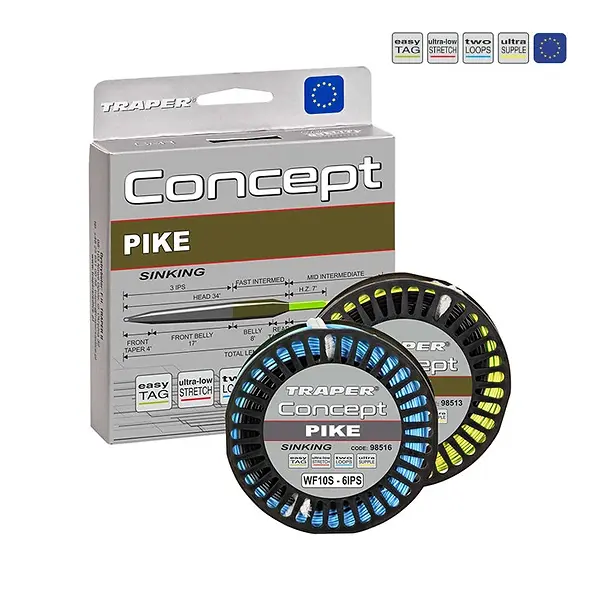
The first question is obvious: why do I need a sinking fly line? The most natural answer is: to get the fly deeper. And of course that is correct. It is just only part of the answer.
In practice, a line’s sink rate affects much more than fishing depth. It also determines how fast we can retrieve a fly while keeping it at the required depth, how the setup behaves during a drift or in strong river current, and today even how effectively we can target fish seen live on systems such as LiveScope. Sinking lines are commonly treated mainly as a solution for deep water. In reality, their use is much broader.
It is not only about metres below the surface
The usual rule seems simple:
-
shallow — floating,
-
a little deeper — intermediate,
-
really deep — sinking.
In practice, that is a major simplification. Imagine fishing water only two metres deep. Do we need a sinking line there? If we want to retrieve the fly slowly, perhaps not. But things change once we start fishing faster: short, aggressive strips with minimal pauses, or a continuous two-handed retrieve — the roly-poly. Every pull moves the setup not only towards us, but also towards the surface. The faster the retrieve, the stronger that effect becomes.
An intermediate line that would keep a streamer a metre or a metre and a half below the surface on a slow retrieve can start lifting it almost to the top when stripped aggressively. Suddenly it becomes clear that a faster-sinking line does not have to be about fishing deeper. It can simply let us fish faster while staying at the same depth.
I often reach for sinking lines on water that, in theory, does not require them at all. Not because I want to scrape the bottom. I want to fish the fly fast and aggressively while still keeping it in the chosen layer. That is why I do not choose a line only according to water depth. I also choose it according to how I want to retrieve the fly.
Why fish faster in the first place?
You could of course say: why do I need a faster-sinking line? I will take an intermediate and simply retrieve more slowly. The problem is that I do not always want to retrieve slowly. When pike are actively feeding, it is rarely an issue. They can shoot several metres up or sideways to take a fly being worked well away from where they were holding. Things get much more interesting when they are not feeding actively.
Pike can sit hidden in weed across huge underwater meadows, sometimes at four or five metres — where water clarity allows vegetation to grow that deep. At other times they may sit quite high in the water but tucked between pondweed stems. A conventionally retrieved streamer often does not impress them much in those situations. The fish rises, follows for a moment, looks at the fly and… that is the end of the story.
In those situations I use probably the simplest mechanism available to us: predatory instinct. I retrieve the fly fast and as close to the fish’s holding position as possible. It should appear suddenly, stay within range for a moment and immediately start disappearing. I do not give the pike much time to inspect it and decide whether it feels like eating. That is when the completely reflexive strike so often happens: first it hits, and only afterwards can it wonder: why did I do that?
But to retrieve a fly like that one, two or several metres below the surface, you first have to keep it there. And this is exactly where an intermediate line starts losing out to a faster-sinking one. These are precisely the situations for which I choose Traper tackle and fly lines.
Pike do not disappear in summer. They change location
Many fly anglers fish hard for pike in May and then, as summer arrives, conclude that the fish have “stopped taking” .Many don’t pick up their pike fly rods again until autumn.
Very often the problem is not that pike have stopped feeding. We are simply still looking for them where they were in spring, using the same methods.
As temperature, light levels, vegetation and food availability change, the fish often move considerably deeper. In clear lakes, underwater weedbeds can extend down to four or five metres. And that is often exactly where the bigger fish are hiding.
If we keep fishing an intermediate line a metre below the surface, we can spend half a day working a great fly several metres above the fish. Sometimes they are active and will rise a long way to the fly, but more often we simply go home once again thinking that “they were not taking today”.
For me, being able to follow the fish deeper while still keeping a normal — and sometimes very fast — retrieve completely changed summer pike fishing. I am no longer tied to one layer of water simply because that happens to be the line on my reel.
And this is where you really see the difference between “I have a sinking line for deep water” and “I can fish where the fish actually are at that moment”.
S1/S3 or S3/S6?
The labels Traper Concept Pike Sinking S1/S3 and Traper Concept Pike Sinking S3/S6 should not be treated as a ready-made depth chart. In lines with different-density sections, the individual zones of the head sink at different rates. In our versions, the slower line works in the S1/S3 range and the faster one in S3/S6. But where the streamer actually ends up is determined by the whole setup: sink time, cast length, retrieve speed, boat drift, current, fly design and weight, and leader length.
That is why S1/S3 can be an excellent choice even in relatively shallow water when we want to fish fast. I choose S3/S6 when I want to reach a deeper layer more quickly or keep the fly there for longer.
In the simplest terms:

This is a starting point, not a recipe. An S3/S6 retrieved very quickly can fish relatively shallow, while an intermediate line left to sink long enough can eventually reach the bottom. The actual fishing depth is always the result of the sink rate of the whole setup and the speed at which we retrieve it.
Drift fishing — how much of the cast do we actually use?
When fishing from a drifting boat or belly boat, there is one more factor: we are moving too. Wind pushes us along even when we use a drift sock or make small corrections with our fins.
Let’s say we cast 15–20 metres and want to fish the fly at three or four metres. After the cast, we need to give it time to sink. At the same time, however, the boat is drifting towards the line, the distance is shrinking and slack starts to appear — which of course has to be managed continuously. If the line sinks slowly, it can take a dozen or even several dozen seconds before the streamer reaches the right depth. Only then do we really start fishing, but by that point a substantial part of the original distance has already disappeared.
We make a few effective strips and a moment later the fly is already close to the boat, where it starts rising towards the surface. With a shorter cast it gets even worse. A faster-sinking line shortens that dead time and extends the part of the retrieve during which the fly is actually in the layer we want to fish. To me, that matters far more than the IPS number printed on the box.
River fishing — sometimes one metre makes a huge difference
We tend to associate sinking lines for large streamers mainly with pike and lakes. But the same physics applies when fishing for huchen or taimen. We cast downstream and across the current, bring the line under tension and start working the streamer across the river. The current not only moves the fly sideways, it also lifts the whole setup towards the surface.
Of course, a huchen, taimen or pike can rise from a much deeper holding position to follow a fly. That does not mean we should always rely on the fish to do all the work for us. In many rivers, two or three metres is already a proper hole. Often we are not fighting for several extra metres. It may be enough to fish the streamer one metre deeper instead of just under the surface, closer to where the fish are holding. In strong current, that one metre can make a bigger difference than changing the colour of the fly yet again.
LiveScope — here, seconds matter
LiveScope changes the game even more. We are no longer casting only towards a promising drop-off, hump or weed edge. We can see a specific fish. We know where it is, how deep it is holding and whether it is moving. The problem is that the situation keeps changing: one fish stays put, another swims on, a third turns around a moment later. Add the movement of our boat to that.
That is why an accurate cast is not enough. We still have to get the fly to the right depth, and do it quickly. If a pike is four, five or six metres below the surface, an intermediate line may simply be too slow. We can make a perfect cast, but by the time the streamer reaches the fish, the situation may already be completely different.
In this kind of fishing, sink rate stops being a technical specification on the packaging and becomes part of the presentation. The fly needs to be next to the fish here and now. And although I know from experience that pike can turn back to a Pike Terror fly and attack it again, I would rather present it properly the first time than rely on luck afterwards.
The line sinks. What about the fly?
The line itself may sink quickly, but there is still a streamer on the end of it, and a large fly creates drag in the water. Length alone is not the whole story. A slim 20 cm streamer made from the right materials behaves very differently from a wide-profile fly with a foam disc at the front and a Wiggle or Dragon Tail.
Nayat / Snow Runner, synthetics, flash or a well-made Dubbing Brush let us build a large profile without turning the fly into a wet mop, but we cannot cheat physics: the volume of the streamer affects both casting and sink rate.
One more thing that is easy to forget is leader length. With a fast-sinking line, a light fly and an excessively long leader, the line can sink noticeably deeper while the streamer travels above it.
That is why, with faster-sinking lines and lighter flies, a shorter leader usually works better, allowing the whole setup to sink more evenly instead of fishing at two different depths. It is a general rule that applies both on stillwaters and on rivers.
If the fly is completely unweighted, it may sink noticeably slower than the sinking head. In normal fishing we can simply wait. With LiveScope, those are exactly the few or dozen seconds we can least afford to lose. That is why in our pike flies we often use a light 0.6 or 0.9 g weight. These are still very comfortable weights to cast, while clearly helping to get the streamer down quickly. The lines described here handle flies like these without any problem even in #9.
A lightly weighted fly also casts better than a comparable unweighted design — but that is a subject for another article.
Where did this project come from?
The reason was simple: I could not find the lines I wanted to buy myself. For years my reference point was the Guideline Pike and later the Predator. They had longer heads, sensible weights and cast large flies very well. The series eventually disappeared from the market, and its sinking options stopped at S1/S3. I wanted something faster.
At the same time, for several years I have seen two clear trends on the market: shorter and shorter heads, and more and more weight. A short, heavy head has its advantages. You can give it a hard punch and even with less-than-perfect technique a big fly will still travel those few metres. There is plenty of power, the rod loads deeply and everything feels as if it “casts itself”. The problem is that you then have to cast it for several hours.
With #10 heads weighing around 28–30 grams, I am not particularly keen on that. My rod probably is not either. So together with Traper we took a different approach: a longer head, sensible weight and a design that lets you cast a large fly normally instead of simply shooting it out.
And it is not only the specifications and handling that are user-friendly — the price is too. At PLN 229, it is often less than half the price of comparable lines from well-known manufacturers.
We were also helped with testing successive versions by Piotr Stopczyński. We went through several prototypes and revisions before arriving at the design I have been fishing regularly since last season.
Less false casting, more fishing
The head is 34 feet long, about 10.4 m. In #9 it weighs 22 g, and in #10, 24 g. That is enough to cast genuinely large pike streamers, including lightly weighted ones.
The geometry, weight and materials also mean that the setup does not need a long build-up. Even with a very large fly, you can cast practically the whole line after one, or at most two, false casts.

Full-line casts with Traper Concept sinking lines and large streamers over 20 cm long.
You can see it in the videos above. This is not a 30-metre casting contest, nor am I suggesting that there is no point going fishing unless you can reach those distances. Very often they are simply unnecessary. The point is that, thanks to the design of these lines, a long cast with a large streamer can be made surprisingly easily, without repeatedly building up the cast or fighting the tackle.
Sometimes, however, the extra distance really is useful — for example when drift fishing, when the boat is quickly moving towards the line and every additional metre gives us more real time to work the fly in the right layer.
Now do the maths: five to seven unnecessary false casts, often even more. Multiply that by several hundred casts with a #9 or #10 rod over a few hours. By evening your shoulders and back feel as if someone has used you for baseball-bat practice.
And with every unnecessary false cast, the streamer is not fishing. Instead of being in the water, it is flying over your head, the boat, the engine or the person standing behind you. With a large fly on a 4/0 hook or bigger, that is not especially appealing.
Fly fishing is not about making as many false casts as possible. It is about making a good cast efficiently and keeping the fly in the water for as long as possible. A well-matched line saves energy and frustration, but above all it increases the amount of time you are actually fishing.
.
Technical specifications
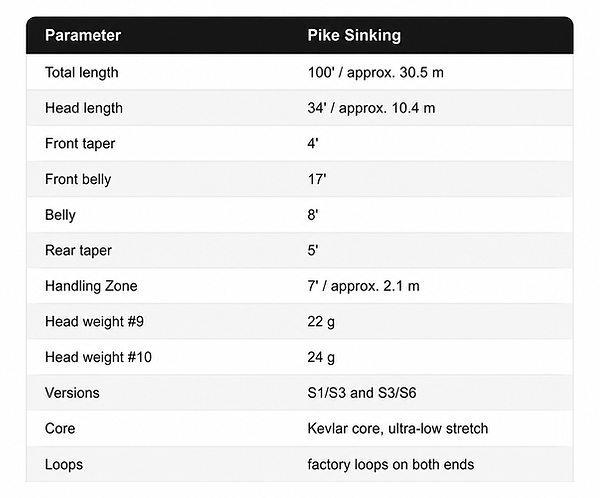

Traper Concept Pike Sinking S1/S3 — line profile and sink-rate zones

Traper Concept Pike Sinking S3/S6 — line profile and sink-rate zones
Behind the head is an approximately 2.1 m Handling Zone — a thicker section of line that is much easier to control in the hand than the thin running line. The individual zones are also separated by contrasting colours, so it is easy to see where the head ends.
With the sinking versions, I also cared about the running line itself. On the old Guideline lines the head sank very well, but the running line — despite being labelled intermediate — stayed relatively shallow. That created a bow in the line and made contact with the streamer less direct. Ours genuinely sinks below the surface. It may sound like a small detail, but once you are fishing several metres down, it stops being one.
Then there is the Kevlar core with very low stretch. I measured this during tests of different lines and the differences between constructions can be surprisingly large, but that is a subject for another article. What matters here is the result: the line responds more directly during the cast, and underwater we can feel the streamer, vegetation, changes in tension and, of course, the take more clearly.
This changed the way I fish
For me, the biggest change is simple: the tackle no longer limits me the way it used to. I can fish effectively at different depths and at different times of year instead of waiting for the conditions in which my particular setup happens to work.
Most importantly, once I changed the way I presented my flies, the number of big pike I started catching increased noticeably. Sometimes it was enough to fish deeper. Sometimes I had to fish both faster and deeper. At other times, speed alone was the key, without changing depth.
And in every one of those situations, the sinking line was the element that allowed me to do exactly what the conditions required.
I do not treat any of this as a set of absolute rules. Every water has its own character, there are countless variables, and there are days when no “magic” piece of tackle or fly will solve the problem. I have deliberately left out plenty of nuances here as well, because there is no single formula that works everywhere.
I see it more as a direction worth exploring if you want to broaden your range of options, extend the season and increase the number of days when chasing pike really makes sense. There are still plenty of accepted ideas and old rules surrounding this kind of fishing, and I hope this article casts a little new light on a subject that can sometimes seem as if it has already been completely figured out.
I have not been able to imagine serious pike fishing without a sinking line for a long time. Now I can simply use one in far more situations than before.